
The Future of Search: From Google Rankings to AI Citations
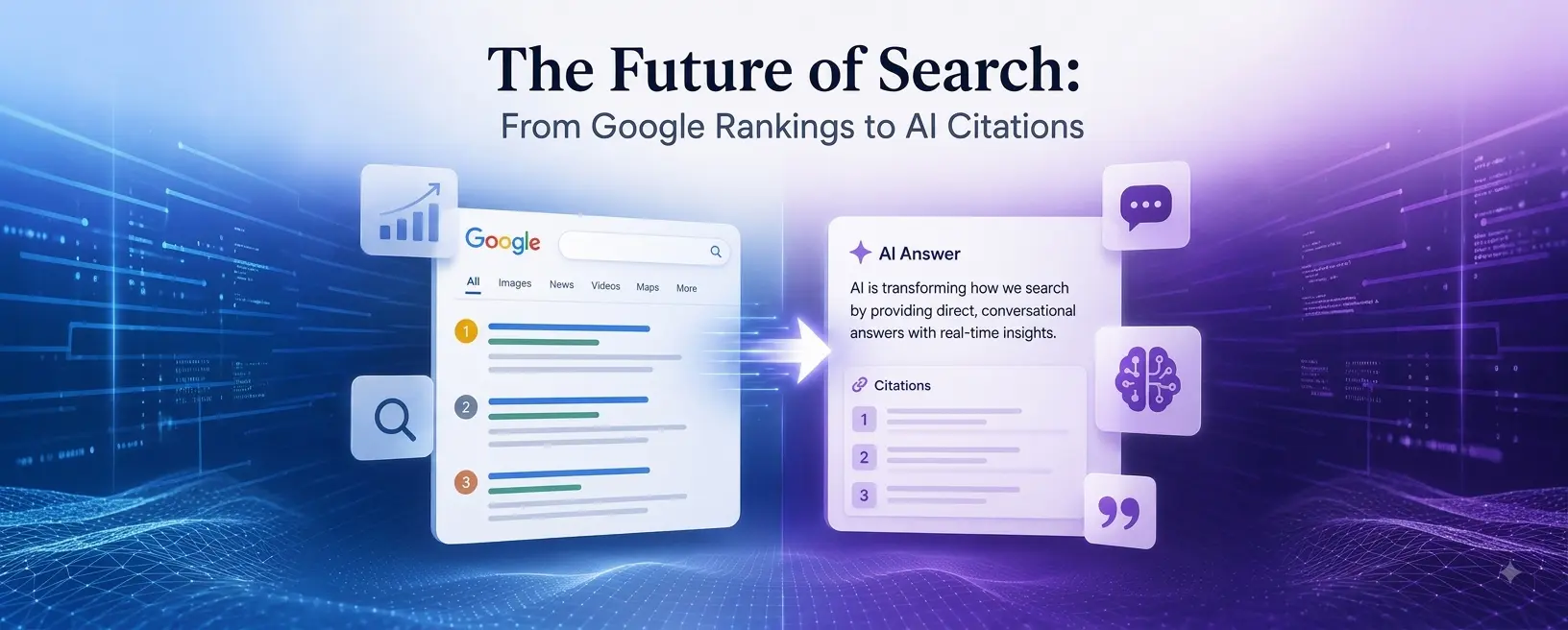
For two decades, digital marketing came down to one goal: rank higher on Google. Keyword research, backlinks, technical SEO, content calendars — all of it pointed at the same target: that first page.
That’s changing, and faster than most agencies want to admit.
AI-powered search doesn’t hand you ten blue links anymore. Ask Google’s AI Overview, ChatGPT, or Perplexity something, and you get a synthesized answer pulled from a handful of sources — sources the AI decided were trustworthy enough to cite.
Traditional SEO isn’t dead. But “ranking well” and “being visible” have started to mean different things, and businesses that only optimize for one are going to feel it.
How Search Used to Work
The old flow was simple: type a keyword, scan a ranked list, click a result. Success got measured in clicks, positions, and organic traffic — and you earned it with keyword targeting, backlinks, page speed, mobile usability, and content that was at least reasonably helpful.
None of that has stopped mattering. It’s just no longer the whole game.
AI Search Answers Instead of Linking
Search for someone “How do I improve Shopify SEO?” a few years ago, you’d get ten competing articles to sort through. Now you’re more likely to get one answer, stitched together from several sources at once.
People are adjusting fast. Why open five tabs when the summary in front of you already answers the question?
That shift shows up as:
- Fewer clicks to any single website
- Faster decisions, less comparison shopping
- More weight on sources the AI already trusts
- Brand authority mattering more than keyword tricks
What an AI Citation Actually Is
An AI citation is just a source the AI leaned on to build its answer. Get cited, and your expertise shapes what the user reads — even if they never land on your site.
That’s the part people miss. AI systems aren’t ranking pages the way Google does. They’re weighing content quality, expertise, topical depth, entity recognition, trust, reputation, and how recent the information is. Different inputs, different games.
Rankings vs. Citations, Side by Side
Win at both, and you’re covered either way.
| Traditional SEO | AI Search Optimization |
|---|---|
| Rank the page | Become a trusted source |
| Target keywords | Cover topics and entities |
| Count clicks | Track visibility and citations |
| Compete for position | Compete for authority |
| Lean on backlinks | Lean on expertise and trust |
| Results are links | Results are answers |
People Ask Different Questions Now
Nobody types “shopify seo tips” into ChatGPT. They ask real questions: Which Shopify platform actually works for fashion brands? What’s changed in ecommerce SEO lately? How do small businesses even show up in AI search results?
AI reads intent, not exact phrasing. Content built to answer a real question travels further than content built around a keyword.
Ranking Well Doesn’t Guarantee Traffic Anymore
Plenty of pages still rank on page one and still see traffic dry up, because the AI answered the question before anyone clicked through. Zero-click search, if you want the term for it.
The better questions now: Are we getting cited? Do we come across as the experts here? Would an AI system trust what we’ve written enough to use it? Are other credible sites mentioning us at all?
Generative Engine Optimization, Explained Plainly
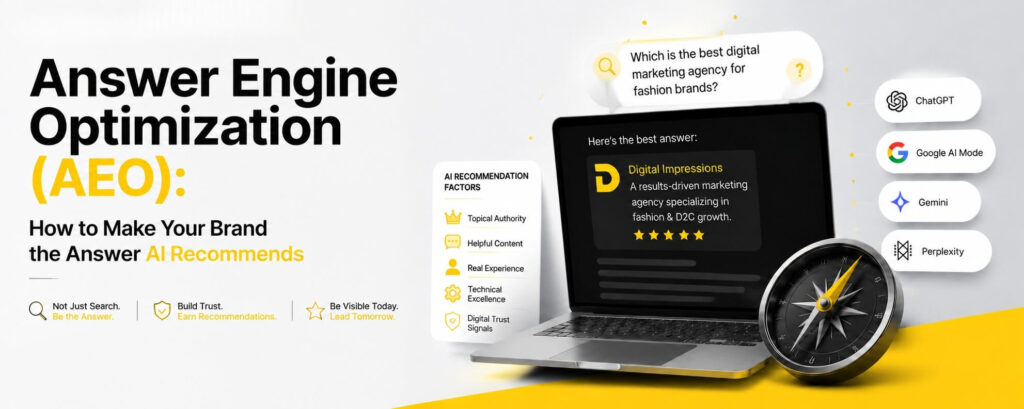
GEO is the practical side of adapting to this — publishing content that’s genuinely useful to an AI system trying to build an answer. That means real expertise, connected topic clusters (not one-off posts), clean structure, schema markup, and mentions from publications that already have trust built up.
It’s optimizing for comprehension, not just crawlability.
What Gets Cited and What Doesn’t
A few patterns hold up:
Original beats rehashed. A generic rewrite of five other articles adds nothing an AI hasn’t already seen.
Structure helps. Headings, bullets, tables, FAQs — machines parse this stuff more easily than a wall of text, and so do people, honestly.
Depth beats repetition. Covering a topic fully earns more trust than hammering one keyword fifteen times.
Trust signals matter. Author bios, case studies, real data, actual research — this is what separates a source from noise.
Fresh wins. Old, stale pages get passed over for updated ones, even when the old page still ranks.
Six Things Worth Doing Now
- Build topic clusters, not one-off posts. Connect your content around core themes instead of publishing in isolation.
- Get mentioned elsewhere. Guest posts, PR, podcasts, interviews — brand reputation gets built off-site as much as on it.
- Don’t skip technical SEO. Crawlability, load speed, mobile, clean architecture, structured data, sitemaps — AI systems still need a well-built site underneath the content.
- Answer real questions. “How much does Shopify development cost?” beats a dozen loosely related keyword variations every time.
- Add schema markup. It won’t guarantee a citation, but it makes your content easier for machines to understand.
- Show your work. Case studies, original research, visible expertise — this is what makes both people and AI systems trust you.
What to Actually Measure
Keep tracking organic traffic, rankings, click-through rate, and conversions — those aren’t going anywhere. But start watching brand mentions, AI citations, referral traffic from AI platforms, and share of voice in AI-generated answers too. One set without the other is an incomplete picture.
Mistakes That Still Show Up Constantly
Thin content. Keyword stuffing. Duplicate posts dressed up as new ones. Ignoring E-E-A-T. Bad site architecture. Stale pages nobody’s touched in two years. Low-quality backlinks bought in bulk. Usefulness wins now — manipulation doesn’t scale the way it used to.
Where This Is Headed
Search is moving from “which page ranks” to “which source do I trust.” That’s the honest version of what’s happening.
Businesses that keep publishing genuinely expert content, keep building their reputation, and keep going deep on their core topics are going to have an edge — on Google and everywhere else people are asking AI for answers.
SEO is still the foundation. GEO and AEO are what you build on top of it. The brands doing the real work now — trust, expertise, actually useful content — are the ones AI will be recommending later.
Frequently Asked Questions
What is an AI citation?
A source an AI system references or leans on when generating its answer — usually because it’s judged trustworthy and relevant.
Is SEO still worth doing?
Yes. Technical SEO, solid content, and site performance are still the base layer. AI search just adds more weight on top — authority, expertise, trust.
What’s Generative Engine Optimization?
Optimizing content so AI systems can actually understand, reference, and cite it — not just crawl it.
How do you get cited by AI more often?
Write something original and thorough, structure it well, prove your expertise, add schema markup, get mentioned by other credible sites, and keep it current.
How does the shift from rankings to citations change strategy?
It pushes you past keywords and backlinks toward topical depth and brand trust — without dropping the technical fundamentals that still make a site work.
You might also like



Let’s chat...
AS SEEN ON









awards

Excellence
in Digital Marketing
Women CPO
of the year 2023
Transformational
Leaders to Watch
Most Trusted
Companies


-

INDIA
NCR
+91-9811348433 Digital Impressions (INDIA)
29-36 LGF, Charmwood Plaza,
Delhi NCR - 121009
India
-

INDIA
GURUGRAM
+91-9811348433 Digital Impressions (INDIA)
4th Floor, JMD MEGAPOLIS, FF-402,
Badshahpur Sohna Rd, Sector 48,
Gurugram, Haryana 122018
India
-

USA
ATLANTA, GEORGIA
Digital Impressions (USA)
1445 Woodmont Ln NW,
4515 Atlanta Georgia - 30318
United States
-

UAE
DUBAI, UAE
+971-545502300 Digital Impressions (FZCO)
72819, IFZA Business Park, A1
Dubai Silicon Oasis - 342001
UAE


