
How AI is Transforming eCommerce for Fashion Brands in India
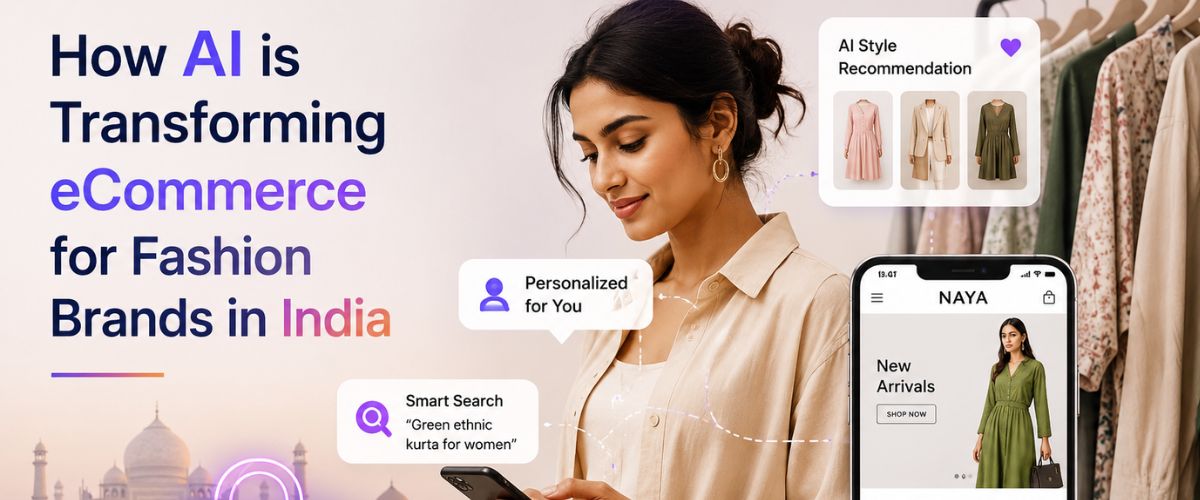
Indian fashion has always had a certain chaos to it — in the best way. Thousands of designers, labels, and D2C brands competing for the same scroll, the same cart, the same wallet. For years, the brands that won were the ones with the deepest pockets. Bigger ad budgets. More SKUs. More influencers on retainer.
That’s changing.
AI is not the silver bullet everyone claimed it would be in 2023. But it’s also not hype anymore. For ecommerce fashion brands in India, it’s becoming the thing that separates stores that grow from stores that plateau. We’ve seen it firsthand working with fashion and lifestyle brands across Delhi NCR, Dubai, and beyond — and the difference between brands using AI well and brands ignoring it is becoming harder to explain away.
Here’s what’s actually happening.
The Indian Fashion eCommerce Landscape Right Now
India’s fashion ecommerce market crossed $14 billion in 2024 and is on track to hit $35 billion by 2030. That sounds like a rising tide lifts all boats moment — except it doesn’t work that way.
D2C fashion brands in India are dealing with:
- Rising Meta and Google ad CPMs (costs are up 30–40% year-on-year for fashion categories)
- Return rates that can hit 35–45% for apparel
- Consumers who browse on Instagram, research on Google, and expect Amazon-level delivery speed
- International competition from Shein, Myntra, and aggregator platforms eating into discovery
The brands getting ahead aren’t spending more. They’re spending smarter — and AI is the main reason they can.
Where AI is Actually Making a Difference
1. Product Discovery That Doesn’t Rely on Search Terms
Most shoppers on a fashion website don’t know exactly what they want. They know a feeling. “Something festive but not heavy.” “Casual but office-appropriate.” “Ethnic, but modern.”
Traditional search can’t handle that. AI-powered visual search and recommendation engines can.
Tools like Klevu, Searchanise, and Shopify‘s own AI recommendations analyse browsing behaviour, purchase history, and even image attributes to surface products people didn’t know they were looking for. We’ve seen brands using AI-driven product discovery record a 20–30% lift in average session duration and meaningful improvements in conversion rate — not because they changed their products, but because the right person finally found the right thing.
For ecommerce fashion brands selling ethnic wear, fusion clothing, or anything with a strong aesthetic, this matters enormously.
2. Personalised Marketing That Doesn’t Feel Creepy
There’s a version of personalisation that feels like a brand gets you. And there’s a version that feels like someone’s been reading your texts. Indian shoppers — especially the 25–35 age group — know the difference now, and they’re less forgiving of brands that cross that line than they were a few years ago.
AI-powered email and WhatsApp flows, when set up properly, tend to land on the right side. A follow-up email showing the category someone actually browsed. A restock alert for the specific size that was sold out. A Diwali campaign that doesn’t go to the customer who only ever buys for Eid. These aren’t complicated to build — Klaviyo, Omnisend, and Shopify’s own automation tools can handle all of it — but most brands either don’t set them up or set them up once and never revisit the logic.
The impact on any single send is modest. Over six months it isn’t. Brands running segmented, behaviour-based flows consistently see 15–25% better repeat purchase rates compared to brands blasting the same campaign to their whole list.
3. AI-Generated Content at Scale — Done Right
We need to be careful here, because this is where most brands get it wrong.
AI-generated product descriptions, category copy, and ad creatives can save hours. They can also destroy a brand voice in minutes if you let them run without guardrails. We’ve reviewed Shopify stores where every product description reads the same — the same sentence structure, the same adjectives, the same vague “crafted with care” language — and you can tell immediately that no human touched it.
The brands doing this well use AI as a first draft engine, not a final output machine. A writer gives the AI brand voice guidelines, tone examples, and specific product details. The AI generates a draft. A human edits. The output is faster than writing from scratch and better than generic AI copy.
For fashion brands with 200+ SKUs — common for multi-category labels or boutique aggregators — this workflow is genuinely game-changing. Getting unique, on-brand descriptions across your entire catalogue used to take weeks. Now it takes days.
4. Returns Prediction and Inventory Planning
Returns are where fashion ecommerce quietly bleeds out. A brand might look profitable on gross revenue and then discover that returns, restocking, and reverse logistics are eating 18–22% of margins.
AI tools connected to your Shopify backend can now:
- Flag orders with high return probability (based on customer history, product category, size selection behaviour)
- Prompt intervention before dispatch — a size guide popup, a “customers also bought” suggestion for a better fit
- Forecast which SKUs will overstock and which will sell out, so buying decisions get smarter over time
This is not science fiction. Shopify’s native analytics, combined with third-party tools like Triple Whale or Glew, make this accessible for mid-size brands without enterprise budgets.
5. Performance Marketing That Optimises Itself
Running Meta and Google ads for fashion used to mean constant manual adjustment. Check CTR. Adjust creative. Test audiences. Pause underperformers. Repeat.
AI-powered campaign management — through Meta’s Advantage+ campaigns, Google’s Performance Max, or tools like Madgicx and Revealbot — does most of this automatically. The algorithms respond to real-time signals faster than any human campaign manager can.
But here’s what most agencies won’t tell you: the AI is only as good as the creative and the data you feed it. Advantage+ with weak creativity will spend your budget efficiently on the wrong people. The human job has shifted from manual optimisation to strategic direction — better briefs, stronger creative testing, cleaner audience signals.
At Digital Impressions, we work with fashion brands to build the creative infrastructure that makes AI-powered media buying actually work. The technology handles the bids. We handle the brand thinking.
What AI Cannot Do (And Brands Keep Expecting It To)
It cannot build a brand. It cannot replace a founder’s taste. It cannot tell you whether your new collection will resonate with a 28-year-old woman in Bangalore who buys independently but follows fashion closely.
Some Indian D2C fashion brands have over-automated their customer experience — chatbots that can’t answer nuanced queries, automated responses that feel cold during a complaint — and lost the warmth that built their community in the first place.
The fashion brands getting real mileage from AI in India have one thing in common — they’re not trying to automate the brand. They’re using AI to handle the repetitive operational stuff so their people can spend more time on the things that actually build loyalty: the product, the story, the community you can’t manufacture with a prompt.
A Real Example: What This Looks Like in Practice
One Delhi label we worked with is a good example. Solid product, genuine following, and a Meta ad budget that was producing less and less each quarter. The ads weren’t broken. The store was. People would land, browse two or three pages, find nothing that grabbed them, and leave.
We rebuilt how products surfaced on collection pages — AI-driven recommendations tied to browse behaviour rather than just category logic. Put a “complete the look” section on product pages so the store did some of the styling work for you. And broke apart their email list so someone who’d only ever bought ethnic wear stopped receiving the same campaign as someone who shops their basics line.
Within 90 days: bounce rate dropped 22%, average order value went up 18%, and their email revenue as a percentage of total revenue grew from 8% to 19%.
No new products. No bigger ad budget. Just a smarter store.
Where This is All Heading
The next wave for ecommerce fashion brands in India is AI-assisted size and fit — virtual try-ons, AI fit recommendations based on body measurements and past purchases. Brands like Myntra have been experimenting with this for a while. The technology is becoming affordable enough for independent D2C labels.
The brands that build the data infrastructure now — clean customer profiles, well-tagged product catalogues, consistent purchase history — will be the ones who can actually use these tools when they mature.
The Bottom Line
AI is not going to save a fashion brand with a bad product or a broken supply chain. But for brands that have the fundamentals right — good product, real customers, a story worth telling — it’s removing the operational drag that used to slow growth down.
Indian ecommerce fashion brands that figure this out now will have a meaningful head start. Not because AI is magic, but because compounding advantages are real — and every month of smarter personalisation, cleaner data, and better-optimised ads puts distance between you and competitors who are still running things manually.
The question isn’t whether to use AI. It’s whether you’re using it well.
Frequently Asked Questions
Q: Do Indian fashion brands really need AI, or is it just a trend?
It depends on what you’re trying to solve. If your store is early-stage and you’re still finding product-market fit, AI tooling is probably not your priority. But if you’re doing consistent revenue and hitting growth ceilings — rising ad costs, high returns, flat repeat purchase rates — AI tools can address each of those specifically. It’s not a trend for brands at that stage. It’s infrastructure.
Q: What’s the easiest AI tool to start with for a Shopify fashion brand?
Start with your email flows. Klaviyo’s AI-powered segmentation and send-time optimisation is accessible, directly tied to revenue, and doesn’t require a developer to set up. Most brands see a measurable improvement within the first 60 days.
Q: How much does it cost to implement AI features on a Shopify store?
It varies widely. Basic AI recommendations and email personalisation can be up and running for under ₹15,000–₹25,000 per month in tool costs. More advanced implementations — custom AI search, returns prediction, dynamic pricing — cost more and usually need agency support to set up properly.
Q: Can small Indian fashion brands compete with Myntra and Nykaa Fashion using AI?
They’re not competing on the same terms, and that’s fine. Myntra’s advantage is scale and distribution. A D2C brand’s advantage is community, curation, and direct customer relationships. AI helps D2C brands protect and extend those advantages — better personalisation, smarter inventory, stronger retention — rather than trying to out-scale platforms that will always be bigger.
Q: How does Digital Impressions help fashion brands with AI implementation?
We work across the full stack — Shopify store development, performance marketing, and retention strategy. For fashion brands specifically, we help integrate AI-powered tools into the store architecture, build the data flows that make personalisation possible, and manage campaigns in a way that uses AI’s media-buying efficiency while keeping the brand’s creative direction human-led. You can see some of our work at thedigitalimpressions.com/work.
You might also like
The Impressions Edit – September ’26
Expert Insights: How AI Is Changing E-commerce Marketing
Marketing Automation Is Evolving: Welcome to the Era of AI Agents


Let’s chat...
AS SEEN ON









awards

Excellence
in Digital Marketing
Women CPO
of the year 2023
Transformational
Leaders to Watch
Most Trusted
Companies


-

INDIA
NCR
+91-9811348433 Digital Impressions (INDIA)
29-36 LGF, Charmwood Plaza,
Delhi NCR - 121009
India
-

INDIA
GURUGRAM
+91-9811348433 Digital Impressions (INDIA)
4th Floor, JMD MEGAPOLIS, FF-402,
Badshahpur Sohna Rd, Sector 48,
Gurugram, Haryana 122018
India
-

USA
ATLANTA, GEORGIA
Digital Impressions (USA)
1445 Woodmont Ln NW,
4515 Atlanta Georgia - 30318
United States
-

UAE
DUBAI, UAE
+971-545502300 Digital Impressions (FZCO)
72819, IFZA Business Park, A1
Dubai Silicon Oasis - 342001
UAE


